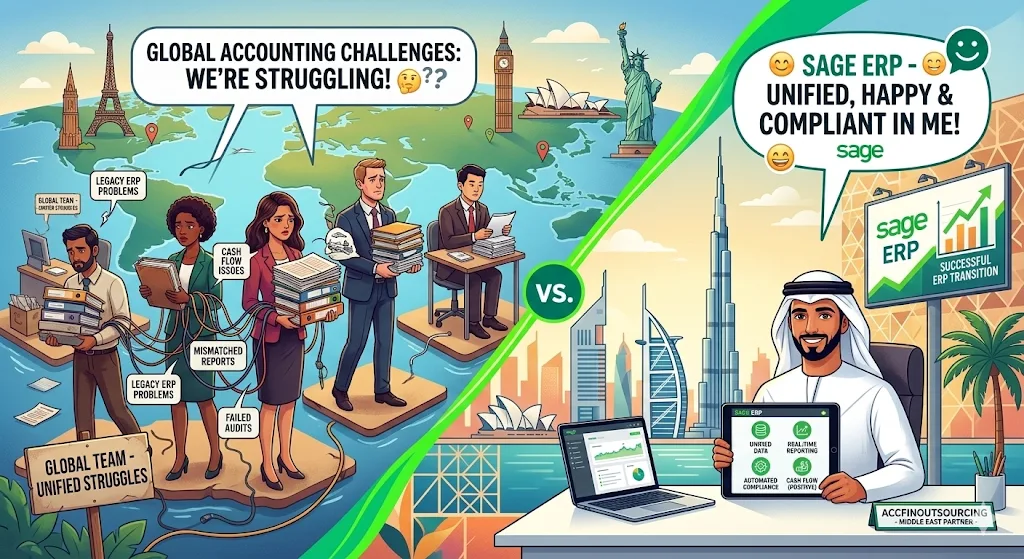
Most businesses don’t realize they have the wrong ERP.
Until:
- An audit exposes reporting gaps
- An invoice gets rejected under structured e-invoicing
- VAT reconciliation doesn’t match
- Cash flow tightens unexpectedly
- Month-end close drags for weeks
The real test of an ERP is not its interface.
It is whether it can confidently answer critical financial, operational, and compliance questions — instantly.
If your ERP cannot answer the following ten questions with real-time, drill-down data, it may be holding your business back.
1. What Is My Exact VAT Position — Right Now?
Not last month.
Not after Excel adjustments.
Right now.
Your ERP must instantly show:
- Output VAT
- Input VAT
- Net payable/refundable
- VAT by entity
- VAT by transaction type
If your finance team needs spreadsheets to reconcile VAT, your system is not built for 2026 compliance in the UAE and GCC.
2. Which Invoices Would Fail Under Structured E-Invoicing Rules?
With 2026 structured reporting requirements approaching, your ERP should:
- Validate tax codes automatically
- Flag missing TRN fields
- Ensure invoice sequencing integrity
- Detect formatting inconsistencies
If invoice validation happens manually — risk increases.
A compliance-ready ERP prevents rejection before submission.
3. Can I Drill Down from My P&L to the Original Transaction in Seconds?
Modern ERP systems must allow:
Dashboard → P&L → Account → Journal → Invoice → Approval Trail
Without multiple exports.
Without manual reconciliation.
If your ERP requires data extraction to understand variances, it limits decision-making speed.
4. How Long Does My Month-End Close Take — and Why?
Ask yourself:
- Do you know exactly what delays your close cycle?
- Can you see pending reconciliations in real time?
- Are approvals automated?
- Is intercompany elimination automatic?
If month-end feels like controlled chaos, your ERP lacks workflow intelligence.
Best-in-class systems reduce close time dramatically through automation and structured approvals.
5. What Is My Real Cash Flow Forecast for the Next 90 Days?

Not a guess.
Not a manually updated projection.
A modern ERP should integrate:
- Accounts receivable
- Accounts payable
- Deferred revenue
- Recurring billing
- Project billing
- Committed expenses
Without predictive cash visibility, businesses operate reactively.
6. Can I Consolidate Multi-Entity Financials in One Click?
Many GCC businesses operate across:
- UAE mainland
- Free zones
- KSA
- Qatar
- Bahrain
If your ERP cannot:
- Consolidate multi-entity results
- Eliminate intercompany transactions
- Handle multi-currency adjustments
- Generate group-level dashboards
You are managing growth manually.
Scalable businesses require centralized visibility.
7. Do I Have a Complete Audit Trail for Every Financial Entry?

Audits are becoming data-driven across the region.
Your ERP must show:
- Who created the transaction
- Who approved it
- When it was modified
- What changes were made
- Segregation of duties compliance
If this data cannot be extracted in minutes, audit risk increases.
8. What Is My Revenue Recognition Status?
For subscription, services, or project-based businesses:
- How much revenue is deferred?
- What has been earned but not billed?
- Are recognition rules automated?
- Can I track revenue by contract?
Revenue misstatement is one of the top audit triggers.
ERP systems must automate recognition logic.
9. Which Customers Are Most Profitable — and Why?
Not just revenue.
Profitability.
By:
- Customer
- Product
- Project
- Region
- Sales team
If your ERP cannot calculate contribution margins with cost allocation logic, strategic decision-making suffers.
10. Can My ERP Adapt to Regulatory Changes Without Rebuilding the System?
The Middle East regulatory landscape is evolving:
- E-invoicing
- Corporate tax
- VAT refinements
- Reporting modernization
Ask:
- Can new tax codes be configured easily?
- Can reporting formats be adjusted?
- Can integrations scale?
- Is the system cloud-native?
If every regulatory update requires heavy customization, your ERP lacks agility.
The Core Reality
ERP systems are not just accounting tools.
They are:
- Compliance engines
- Data governance systems
- Forecasting tools
- Growth enablers
- Risk management platforms
If your ERP cannot answer these ten questions confidently and instantly, you are likely:
- Overworking your finance team
- Increasing compliance exposure
- Losing forecasting accuracy
- Limiting scalability
- Delaying strategic insight
The wrong ERP doesn’t fail loudly.
It fails silently — through inefficiency.
What a Modern ERP Should Deliver
Here is what businesses should expect today:
| Capability | Minimum Expectation in 2026 |
|---|---|
| VAT Reporting | Automated, real-time |
| E-Invoice Validation | Built-in compliance checks |
| Audit Trail | Complete, timestamped |
| Multi-Entity | Native consolidation |
| Dashboards | Live, drill-down enabled |
| Revenue Recognition | Rule-based automation |
| Forecasting | Predictive cash modeling |
| Regulatory Updates | Cloud-driven adaptability |
If your current system does not meet this baseline, the cost of delay will increase.

Why Businesses Are Moving Toward Sage Intacct
When evaluated against the 10 critical questions above, Sage Intacct delivers:
- Real-time financial dashboards
- Strong audit trails
- Automated VAT configuration
- Multi-entity consolidation
- Revenue recognition automation
- Cloud-native flexibility
- Structured reporting capability
It is built specifically for financial governance and compliance maturity.
However, ERP capability depends on correct configuration.
That is why working with an experienced regional partner like Accfin Consulting is equally critical.
Accfin aligns system architecture with:
- UAE compliance frameworks
- GCC multi-entity structures
- E-invoicing readiness
- Corporate tax governance
- Long-term scalability
Software alone is not enough.
Implementation expertise determines success.
If your ERP cannot answer these ten questions:
You do not have a reporting problem.
You have a system maturity problem.
And in a compliance-driven Middle East environment approaching 2026, system maturity is non-negotiable.
The right ERP transforms compliance into competitive advantage.
The wrong ERP quietly limits growth.
If you would like a structured ERP capability assessment based on these ten questions, contact info@accfinoutsourcing.com for a confidential consultation.
We will evaluate your current system against 2026 compliance benchmarks and provide a practical modernization roadmap using Sage Intacct and proven regional implementation expertise from Accfin Consulting.